How 2026 commercial filmmaking trends challenge the tourism promotion industry to abandon excess and embrace intention
The problem everyone recognises but few confront
There's a scene that repeats itself in DMO boardrooms and tourism authority offices around the world: the creative briefing that begins with "we want something cinematic and emotional" and ends with a list of 47 points of interest that must appear in the film. The castle, the beach, the gastronomy, the handicrafts, the festival, the new cycle path, the viewpoint, the traditional market — all in 90 seconds, all with equal importance, all competing for the attention of a viewer who has already seen hundreds of identical videos.
The result is predictable: technically competent but emotionally empty films. Beautiful drone shots that could be anywhere. Generic epic music. Smiling faces of actors who don't belong to that territory. The viewer watches but doesn't feel. They remember seeing "a nice video of some place", but cannot say which.
The recently published Commercial Filmmaking Trend Report 2026, by Filmsupply and Musicbed, puts its finger on this wound with disarming clarity. The report, focused on the trends defining commercial cinema this year, offers a diagnosis that the tourism promotion industry needs to hear — and a path that requires courage to follow.
The trinomial that changes everything
At the heart of the report lies a seemingly simple provocation: "The challenge is convincing clients that simple is enough." The phrase introduces what may be the most necessary manifesto for anyone producing tourism films in 2026:
Keep it Cinematic. Keep it Honest. Keep it Simple — on purpose.
This is not a call for minimalism due to budget limitations or lack of ambition. It's exactly the opposite: intentional simplicity demands more craft, more creative courage, and more confidence in the power of narrative than the "more is more" approach that dominates the sector.
"Cinematic" isn't a filter, a LUT, or a collection of visual tricks. It's artistic vision. It's intentionality. It's choosing to show only what matters and cutting everything that doesn't serve the story. When we strip away the tricks and gimmicks, we're forced to get the fundamentals right: light, composition, rhythm, emotion.
"Honest" means abandoning the temptation of spectacle for spectacle's sake. It means trusting that a true moment — a conversation in a market, an artisan's gesture, the silence of a landscape at dawn — has more power than a thousand drone shots flying over monuments.
"Simple — on purpose" is perhaps the hardest to accept. It implies resisting the pressure to include everything, to satisfy all stakeholders, to justify the investment through quantity. It implies believing that a film that says one thing well is worth more than a film that says twenty things poorly.
Keep it Human: the 2026 imperative
If the trinomial defines the approach, "Keep it Human" defines the content. The Filmsupply report is unequivocal: the future of commercial cinema belongs to those who tell human stories.
We live in a paradoxical moment. Production tools have never been more sophisticated — drones, stabilisers, cameras with extraordinary capabilities, artificial intelligence capable of generating impossible images. And yet, audiences are hungry for authenticity. Saturated with digital perfection, they seek human imperfection. Tired of spectacle, they want truth.
For the tourism promotion industry, this represents a paradigm shift. For decades, the dominant model has been to show the destination as scenery — beautiful, imposing, desirable. The territory was the protagonist, people were extras. The implicit message: "see how beautiful this place is; come here".
What 2026 demands is different. It asks that people be the protagonist and the territory be the context where their stories unfold. Not "see this place", but "see who lives this place, how they live it, what they feel living it". The shift is subtle in formulation but radical in its implications.
Character Stories: the mosaic as message
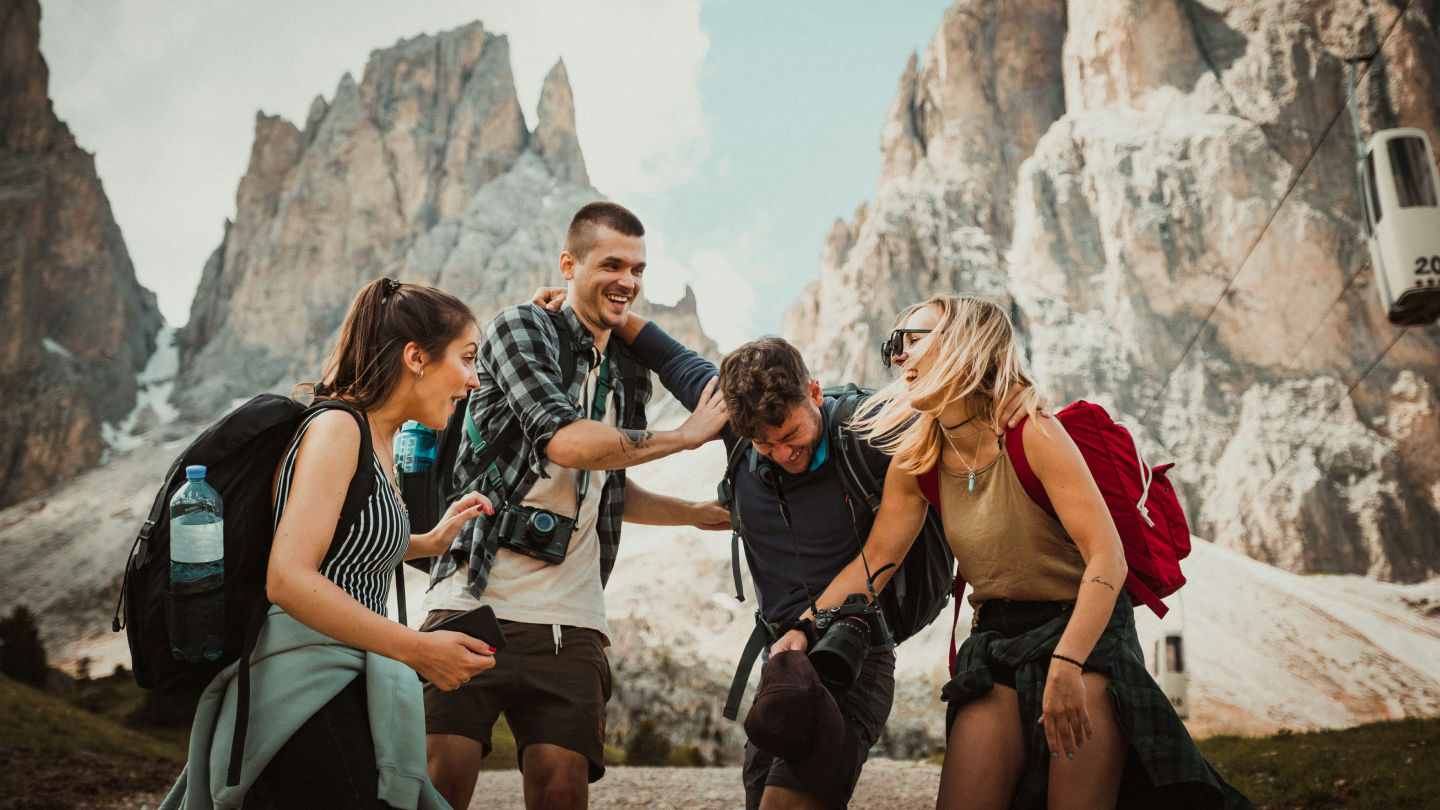
One of the most relevant trends identified in the report is the rise of "Character Stories" — narratives that weave together multiple people, multiple lives, multiple points of truth into a collective emotional portrait.
The report explains: audiences want to see themselves represented in the work. Not the idealised version, not the simplified version — the real version. They connect with ensembles because they see their own routines, hopes, and contradictions reflected through many, not just one.
For a tourism film, this means abandoning the generic protagonist — the photogenic couple on honeymoon, the perfect family on holiday — and embracing the real diversity of those who inhabit and visit a territory. The student discovering a hidden café. The fisherman mending nets at dawn. The grandmother teaching the traditional recipe. The cyclist pausing to catch their breath at the top of the mountain. Individually, they're moments. Together, they're a shared world.
The technique demands rigour: rhythm, framing, and emotional pacing must unify the characters so they contribute to the same idea rather than compete for attention. Transitions pass emotion from one person to the next. When done with intention, the film becomes a mosaic. The mosaic becomes the message.
The aesthetics of imperfection: Analog Aesthetics
Another trend that resonates deeply with tourism promotion is the return to analog aesthetics — 8mm, VHS, film textures — as emotional triggers.
The report identifies that, for a specific generation now at the peak of their consumer power, these visual imperfections are the language of memory. The degraded image, paradoxically, feels more genuine. The contrast with the hyper-clean digital imagery flooding feeds creates emotional impact.
For tourism films, this offers a powerful tool: the ability to make a destination feel like a memory before the viewer has even been there. Not "come and discover this place", but "remember this place" — even if you don't know it yet. It's a fascinating temporal inversion that works at the unconscious level.
Caution: this isn't about applying a vintage filter over generic images. That would be cosmetic and hollow. It's about using aesthetics as an extension of narrative intention — when it makes sense, when it serves the story, when it amplifies emotion rather than masking it.
Documentary as method, not genre
The report emphasises that documentary approaches are not a stylistic choice or a budget-saving measure — they're a way to create work that connects at a deeper level.
Observation. Natural light. Real locations. Unscripted moments. Real people instead of actors. When someone watches a commercial film built around a real person's experience, they recognise something true. That recognition builds trust. It tells the audience that the brand — or, in our case, the destination — understands them, sees them, respects their reality.
This doesn't mean all tourism films should be documentaries in the formal sense. It means that documentary principles — attention to the real, patience to capture true moments, respect for the people being filmed — should inform the approach even when the format is different.
The challenge of simplicity
We return to the starting point: "The challenge is convincing clients that simple is enough."
The report acknowledges the difficulty. When you pitch a treatment built on minimal camera movement and clean compositions, the frequent response is "but what else?". Clients equate visual complexity with production value. They believe more shots mean more work, that more work means better results.
The filmmaker's job — and, by extension, the job of those who commission tourism films — is to reframe simplicity as intentionality, not laziness. It's treating ads like short films, anchored in character, tone, and emotional logic.
Great cinema creates emotional attachment, and that attachment is what brands — and destinations — are really after. When an audience connects emotionally with a film, they're not just remembering the product or the place; they're associating it with a feeling, a moment, a truth that resonated.
A call for courage
The Commercial Filmmaking Trend Report 2026 ends with a phrase that serves as a challenge to the entire industry: "Say something that matters."
For those producing tourism promotion films, this challenge takes on particular urgency. At a moment when artificial intelligence can generate spectacular images of any imaginable place, the only sustainable competitive advantage is truth. The truth of a territory, its people, its stories.
The future belongs to those who resist noise and embrace intention. To those who trust that an honest moment is worth more than a thousand epic images. To those who have the courage to say one thing well, instead of twenty things poorly.
Keep it Cinematic. Keep it Honest. Keep it Human. Keep it Simple — on purpose.
The audience will thank you. And, more importantly, they will remember.
CIFFT — International Committee of Tourism Film Festivals monitors and promotes excellence in tourism audiovisual production worldwide. This article is part of our ongoing reflection on the trends shaping the industry.